
In this guide:
- What is a 7 pin trailer electrical connector?
- 7 pin trailer connector: what does each pin do?
- Wiring diagram for a 7 pin trailer connector
- Types of 7 pin trailer connectors
- 7 pin connector and electric trailer brakes
- How to install a 7 pin trailer electrical connector
- Common problems and how to fix them
- Best 7 pin trailer electrical connectors to buy
- FAQ — trailer electrical connector 7 pin
- Conclusion
Trailer Electrical Connector 7 Pin: Complete Guide, Wiring Diagram and Best Products
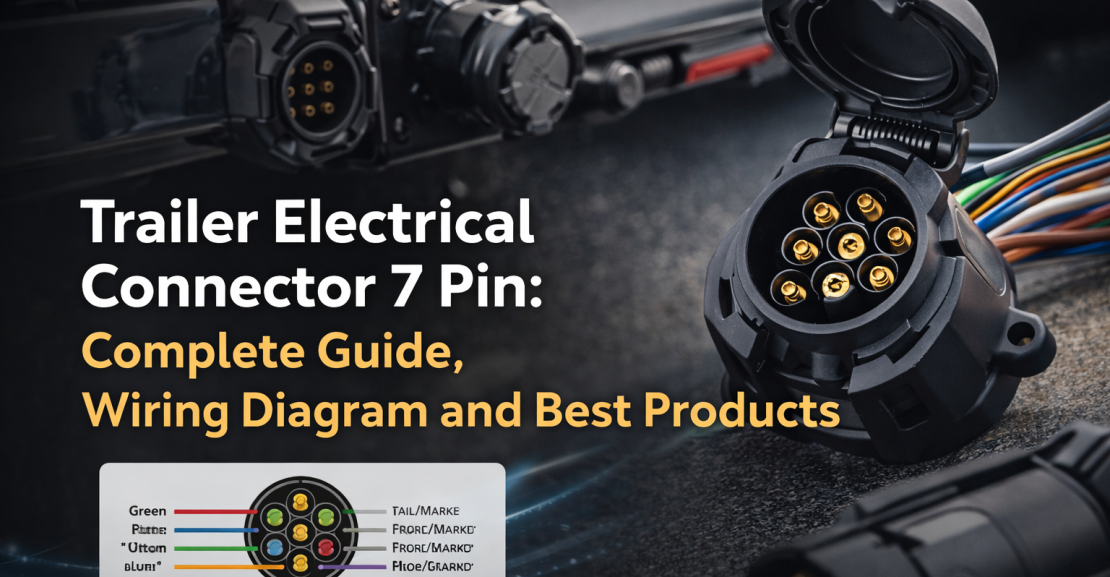
The trailer electrical connector 7 pin is the standard electrical interface between a towing vehicle and a trailer in North America and most of Europe. Whether you are wiring a new trailer, replacing a damaged socket, or troubleshooting lighting and brake issues, understanding how the 7-pin trailer electrical connector works is essential. This complete guide covers everything: pin functions, wiring diagrams, installation steps, electric brake compatibility and the best connectors available today.
View Trailer Electrical Connector 7 Pin
If you are looking to buy a reliable trailer electrical connector 7 pin, we also include our top product picks at the end of this guide — chosen for durability, weather resistance and ease of installation.
What is a trailer electrical connector 7 pin?
A trailer electrical connector 7 pin is a 7-contact plug-and-socket assembly. Standards are defined by SAE International (North America) and ISO (Europe) that carries all the electrical signals needed between a tow vehicle and a trailer. Each of the seven pins is dedicated to a specific function — from tail lights and turn signals to 12V auxiliary power and electric brake control.
The 7-pin format is the most complete standard trailer connector available. It supersedes the older 4-pin and 5-pin connectors by adding dedicated circuits for electric brakes (pin 7) and a 12V auxiliary power feed (pin 4). This makes the 7-pin trailer electrical connector mandatory for trailers equipped with electric brakes, for RVs needing continuous 12V battery charging, and for any setup that needs full bidirectional communication between vehicle and trailer.
When do you need a 7 pin trailer connector?
- Trailers with electric brakes (mandatory — no 4 or 5 pin alternative)
- RVs and campers needing a 12V auxiliary charging circuit
- Boat trailers with an electric winch
- Any trailer where the vehicle must supply auxiliary power to onboard electronics
- Horse trailers, livestock trailers and enclosed cargo trailers
7 pin trailer connector: what does each pin do?
Understanding the pin assignment is the first step to correctly wiring any trailer electrical connector 7 pin. The standard layout below applies to the SAE J560 round 7-pin connector (North American standard) and the ISO 11446 flat 7-pin connector (European standard).
SAE J560 — the North American trailer electrical connector 7 pin (most common in US)
| Pin | Function | Wire color (typical) |
|---|---|---|
| 1 | Ground / Earth return | White |
| 2 | Tail / running lights | Brown |
| 3 | Left turn signal / brake light | Yellow |
| 4 | Right turn signal / brake light | Green |
| 5 | 12V auxiliary power (battery charge) | Blue or Black |
| 6 | Brake controller output (electric brakes) | Blue |
| 7 | Reverse / backup lights | Purple |
For a full reference on connector standards, the NHTSA provides federal motor vehicle safety standards applicable to towing equipment.
Note: Wire colors can vary by vehicle manufacturer. Always verify with a multimeter before connecting — never rely on color alone when wiring a 7-pin trailer electrical connector.
ISO 11446 — European trailer electrical connector 7 pin (flat N-type)
| Pin | Function | Wire color (ISO) |
|---|---|---|
| 1 | Left turn / indicator | Yellow |
| 2 | Rear fog light | Blue |
| 3 | Ground / Earth | White |
| 4 | Right turn / indicator | Green |
| 5 | Right rear / tail light | Brown |
| 6 | Brake light | Red |
| 7 | Left rear / tail light | Black |
Wiring diagram for a 7 pin trailer connector
The wiring diagram for a trailer electrical connector 7 pin is the most searched piece of information about this connector. The diagram for a trailer electrical connector 7 pin maps each pin on the vehicle-side socket to the corresponding circuit on the trailer plug. Below is the standard wiring diagram for the SAE J560 round connector — the most common 7-pin trailer electrical connector used in North America.
How to read the diagram
- The vehicle side (socket) is viewed from the front — the side that faces you when you look at the hitch receiver
- The trailer side (plug) is viewed from the rear — the side that faces away from you when connected
- Pin 1 (ground) is always the center pin or top pin depending on the connector orientation
- Always verify pin positions with a wiring diagram specific to your vehicle make/model before connecting
Wiring a 7 pin trailer connector step by step
- Identify the correct wires on the vehicle harness using a multimeter (test each with lights and brakes activated)
- Strip 3/4 inch of insulation from each wire end
- Connect each wire to the corresponding pin terminal following the diagram above
- Apply dielectric grease to each pin contact to prevent corrosion
- Secure the connector housing and test all functions before use
Types of 7 pin trailer electrical connectors
Not all trailer electrical connectors 7 pin are identical. Two main form factors exist, and choosing the wrong type can result in a non-functional connection.
Round trailer electrical connector 7 pin — SAE J560
The round trailer electrical connector 7 pin format is the dominant standard in the United States, Canada and Australia. It features a round housing with a central locking mechanism and 7 pins arranged in a circular pattern. Key characteristics:
- Large, robust housing — resists vibration and rough handling
- Locking collar prevents accidental disconnection
- Used on most US-spec trucks, SUVs and heavy-duty pickups (Ford, Chevy/GMC, RAM, Toyota Tundra)
- Compatible with most aftermarket trailer brakes and electric brake controllers
Flat trailer electrical connector 7 pin — ISO 11446 / N-type
The flat 7-pin connector is the European standard, commonly found on vehicles sold in the EU and UK. Pin assignments differ from the SAE standard — never connect a European flat connector to a North American round socket without a proper adapter. Key characteristics:
- Compact flat housing with pins arranged in a D-shape
- Standard on European vehicles (VW, Mercedes, Peugeot, Renault, BMW…)
- Pin 2 carries the rear fog light — not present on the US round connector
- No dedicated electric brake pin (this function is handled differently in EU)
Adapters: trailer electrical connector 7 pin to 4 pin and 5 pin
If your vehicle has a 7-pin socket but your trailer only has a 4-pin or 5-pin plug, adapters are widely available. If you need to convert in the other direction (4 or 5-pin vehicle to 7-pin trailer), a 7 pin trailer electrical connector adapter kit with converter module is required — the electric brake and auxiliary power circuits cannot simply be bypassed.
7 pin connector and electric trailer brakes
The trailer electrical connector 7 pin is the only standard connector that supports electric trailer brakes. Pin 6 on the SAE J560 round connector carries the output signal from the vehicle-mounted brake controller to the trailer’s electric brake assemblies.
How electric trailer brakes work with the 7 pin connector
When the driver applies the vehicle brakes, the brake controller sends a proportional voltage signal (typically 0 to 12V) through pin 6 of the 7-pin trailer electrical connector to the electromagnets in each trailer wheel brake assembly. The stronger the braking input, the higher the voltage and the firmer the trailer braking. This requires:
- A brake controller installed in the tow vehicle (proportional or time-delayed)
- A 7 pin trailer electrical connector — 4 and 5 pin connectors have no dedicated brake control pin
- Correct wiring of pin 6 to the brake controller output
- A properly grounded trailer (pin 1 / white wire) — bad ground is the most common cause of brake failure
Vehicle-specific 7 pin connector examples
- 2002 Chevrolet Silverado : factory 7-pin connector located in the truck bed, wired to the integrated trailer brake controller. Pin 6 connects directly to the brake controller output.
- 2001 Dodge RAM 2500 : round 7-pin connector with factory integrated brake wiring. Pin 6 is active when the trailer brake controller is installed.
- Ford F-150 / F-250 : 7-pin blade connector on most models 2004 and newer, with factory-integrated trailer tow package including brake controller pre-wiring.
How to install a trailer electrical connector 7 pin
Installing a new trailer electrical connector 7 pin — whether a replacement plug, socket or full harness — is a straightforward job for anyone comfortable with basic automotive wiring. Here is what you need and how to do it correctly.
Tools and materials needed
- Replacement 7-pin trailer electrical connector (plug, socket, or both)
- Multimeter / test light
- Wire stripper and crimping tool
- Electrical tape or heat-shrink tubing
- Dielectric grease
- Vehicle-specific wiring diagram
Installation steps
- Locate the vehicle harness: most trucks and SUVs have a pre-routed trailer wiring harness ending near the hitch receiver. Find the connector or bare wire ends.
- Test each wire: use a multimeter to identify which wire corresponds to which function (tail lights, left turn, right turn, brake lights, etc.). Do not rely on wire color alone.
- Connect the wires: following the wiring diagram for your connector standard (SAE J560 or ISO 11446), connect each wire to the appropriate pin terminal. Use proper crimp connectors — solder-and-shrink connections are more reliable for a permanent install.
- Apply dielectric grease: coat all pin contacts with dielectric grease before closing the connector housing. This prevents corrosion, which is the leading cause of intermittent 7 pin trailer connector faults.
- Test all functions: with the trailer connected, test each circuit: tail lights, left turn, right turn, brake lights, reverse lights, 12V auxiliary, and brake controller output (if applicable).
- Secure the harness: zip-tie the wiring harness away from heat sources, sharp edges and moving parts. Leave enough slack for full steering and suspension travel.
Common problems with the trailer electrical connector 7 pin and how to fix them
Most issues with a trailer electrical connector 7 pin fall into four categories. Knowing how to diagnose each one will save you time and prevent towing incidents. Here is how to diagnose and resolve each one.
Problem 1: No lights or partial lights on the trailer
Most likely cause: bad ground (pin 1 / white wire). A poor ground is responsible for over 70% of trailer lighting problems. Check that the white ground wire has a clean, secure connection to the vehicle chassis and to the trailer frame — not just to a painted surface.
Problem 2: Electric brakes not working
Most likely cause: open circuit on pin 6, faulty brake controller, or bad trailer ground. Check pin 6 voltage output from the brake controller with a multimeter (should increase proportionally as brakes are applied). Also verify the trailer’s brake electromagnets are intact and properly adjusted.
Problem 3: Blown fuse when trailer is connected
Most likely cause: short circuit in the trailer wiring, or an overloaded auxiliary power circuit (pin 5). Disconnect the trailer, inspect all wiring for chafing or bare wires contacting the trailer frame, and check the load on the 12V auxiliary circuit.
Problem 4: Intermittent connection or flickering lights
Most likely cause: corroded or oxidized pin contacts. Remove the connector, clean all pins with an electrical contact cleaner, apply fresh dielectric grease, and reinstall. Replace the connector if pins are visibly pitted or broken. A quality weatherproof 7-pin trailer electrical connector with gold-plated contacts will significantly reduce corrosion issues.
Best 7 pin trailer electrical connectors to buy
Choosing a reliable trailer electrical connector 7 pin means looking beyond price — connector quality directly impacts safety, especially when electric brakes are involved. Here are our top picks for 2026, selected for build quality, weather resistance and ease of wiring.
1. Hopkins 47545 7 Blade Trailer Socket — Best overall
- Type: Round 7-pin SAE J560
- Material: Reinforced nylon housing, zinc contacts
- Weather resistance: IP67-rated
- Includes: mounting hardware, terminal labels
- Price: ~$18 — $25
The Hopkins 47545 is our top pick for a replacement 7-pin trailer electrical connector socket. Its IP67 weatherproof rating keeps moisture and road debris out of the pin contacts, and the included terminal labels make wiring straightforward even for first-timers.
2. Curt 57007 7-Way RV Blade Trailer Connector — Best for electric brakes
- Type: Round 7-pin SAE J560 (RV blade style)
- Material: Die-cast zinc alloy housing
- Contacts: Nickel-plated for corrosion resistance
- Includes: mounting bracket, wiring harness clamp
- Price: ~$22 — $35
If your setup includes electric trailer brakes, the Curt 57007 is the connector to choose. Its heavy-duty zinc housing and nickel-plated contacts provide reliable continuity on pin 6 — the brake controller circuit where intermittent contact is most dangerous. Our recommended 7 pin trailer electrical connector for commercial and heavy-duty towing.
3. Tow Ready 118072 — Best budget 7 pin trailer connector
- Type: Round 7-pin SAE J560
- Material: Polypropylene housing
- Price: ~$12 — $16
For occasional towing without electric brakes, the Tow Ready 118072 trailer electrical connector 7 pin offers solid performance at a lower price point. Not ideal for permanent heavy-duty installations, but a reliable 7-pin trailer electrical connector for light-duty trailers and recreational use.
Comparison table — Best 7 pin trailer connectors 2026
| Product | Type | Weather rating | Best for | Price |
|---|---|---|---|---|
| Hopkins 47545 | SAE J560 | IP67 | General use / best overall | ~$20 |
| Curt 57007 | SAE J560 RV | High | Electric brakes / heavy duty | ~$28 |
| Tow Ready 118072 | SAE J560 | Standard | Light duty / budget | ~$14 |
Browse our full selection of trailer electrical connectors 7 pin and towing accessories for the complete range of 7-pin connectors, adapters and wiring harnesses.
FAQ — trailer electrical connector 7 pin
What is a trailer electrical connector 7 pin used for?
A trailer electrical connector 7 pin carries all the electrical circuits between a tow vehicle and a trailer: tail/running lights, left and right turn signals, brake lights, reverse lights, 12V auxiliary power and — critically — the electric brake controller signal. It is the only standard connector that supports electric trailer brakes and is required on RVs, horse trailers, boat trailers with electric winches, and any trailer with onboard electronics requiring 12V power.
What is the difference between a 7 pin trailer connector and a 4 pin?
A 4-pin connector carries only the four basic lighting circuits: ground, tail lights, left turn/brake and right turn/brake. A 7-pin trailer electrical connector adds three additional circuits: 12V auxiliary power (for battery charging and onboard accessories), electric brake controller output, and reverse/backup lights. If your trailer has electric brakes, a trailer electrical connector 7 pin is mandatory — there is no workaround with a 4 or 5-pin connector.
Which pin on the 7 pin trailer connector controls the electric brakes?
On the SAE J560 round 7-pin trailer electrical connector (North American standard), pin 6 carries the brake controller output signal. It is typically wired with a blue wire on the vehicle side. When the driver applies the brakes, the brake controller sends a variable voltage (0 to 12V) through this pin to the trailer’s electric brake assemblies. A bad connection on pin 6 of the trailer electrical connector 7 pin will result in no trailer braking — a serious safety hazard.
Are all 7 pin trailer connectors the same?
No. Two main standards exist. The round SAE J560 connector is used in North America (US, Canada, Australia). The flat ISO 11446 (N-type) connector is the European standard. They are not interchangeable — pin assignments differ and the physical connectors are incompatible. Adapters exist but verify compatibility before use. Within the SAE J560 standard, trailer electrical connectors 7 pin from different brands are generally interchangeable.
Why are my trailer lights not working with a 7 pin connector?
The most common cause of trailer lighting failure with a trailer electrical connector 7 pin is a bad ground connection (pin 1, white wire). Check that the ground wire is connected to bare metal on both the vehicle chassis and the trailer frame — not to painted surfaces. The second most common cause is corroded pin contacts: remove the connector, clean with electrical contact cleaner, apply dielectric grease and reconnect. If one specific light is out, check for a blown fuse on that circuit.
Can I use a 7 pin connector with a trailer that only needs 4 pins?
Yes. If your vehicle has a 7-pin trailer electrical connector socket and your trailer only has a 4-pin plug, use a 7-to-4 pin adapter. Only the four basic lighting circuits will be active — the extra pins (auxiliary power, brake controller, reverse) will simply be unused. This is a common setup when towing a basic utility trailer or a small boat trailer behind a truck factory-wired with a full 7-pin socket.
How do I protect a 7 pin trailer connector from corrosion?
The most effective protection for a trailer electrical connector 7 pin is dielectric grease applied to all pin contacts at installation and reapplied annually or after washing the vehicle. Always use a weatherproof connector with a protective cap when not in use — leaving pins exposed accelerates oxidation. For trailers used in saltwater environments (boat launching), rinse the connector with fresh water after each use and inspect pins monthly. Replace any connector showing pitting, green oxidation or broken contacts immediately.
Conclusion: everything you need to know about the 7 pin trailer electrical connector
The trailer electrical connector 7 pin is a critical safety component — particularly when electric brakes are involved. Understanding the pin layout, using the correct wiring diagram and choosing a quality weatherproof connector are the three fundamentals for a reliable towing electrical system.
To summarize:
- Use the SAE J560 round connector in North America — the ISO N-type flat connector in Europe
- Always verify pin functions with a multimeter before wiring — never rely on wire color alone
- Pin 6 carries the electric brake signal — a clean, low-resistance connection on this pin is essential for brake function
- Apply dielectric grease to all pins at installation — it is the single best corrosion prevention measure
- Replace any corroded or damaged trailer electrical connector 7 pin immediately — do not tow with a faulty brake circuit
Ready to replace or upgrade your trailer electrical connector 7 pin? Whether you need a socket, a plug, or a complete wiring kit, choosing the right trailer electrical connector 7 pin for your application makes all the difference. Browse our full selection of connectors, wiring harnesses and towing accessories below — all in stock and ready to ship.